Job search
How to Answer Job Application Questions and Stand Out (With Examples)
One fictional applicant, several worked answers: how to turn real experience into application answers a reader can check.
Theophilus OyetiOct 29, 2026
Already using ChatGPT for your job search? See what another tool would take off your hands, what you'd still manage, and when it's worth paying.
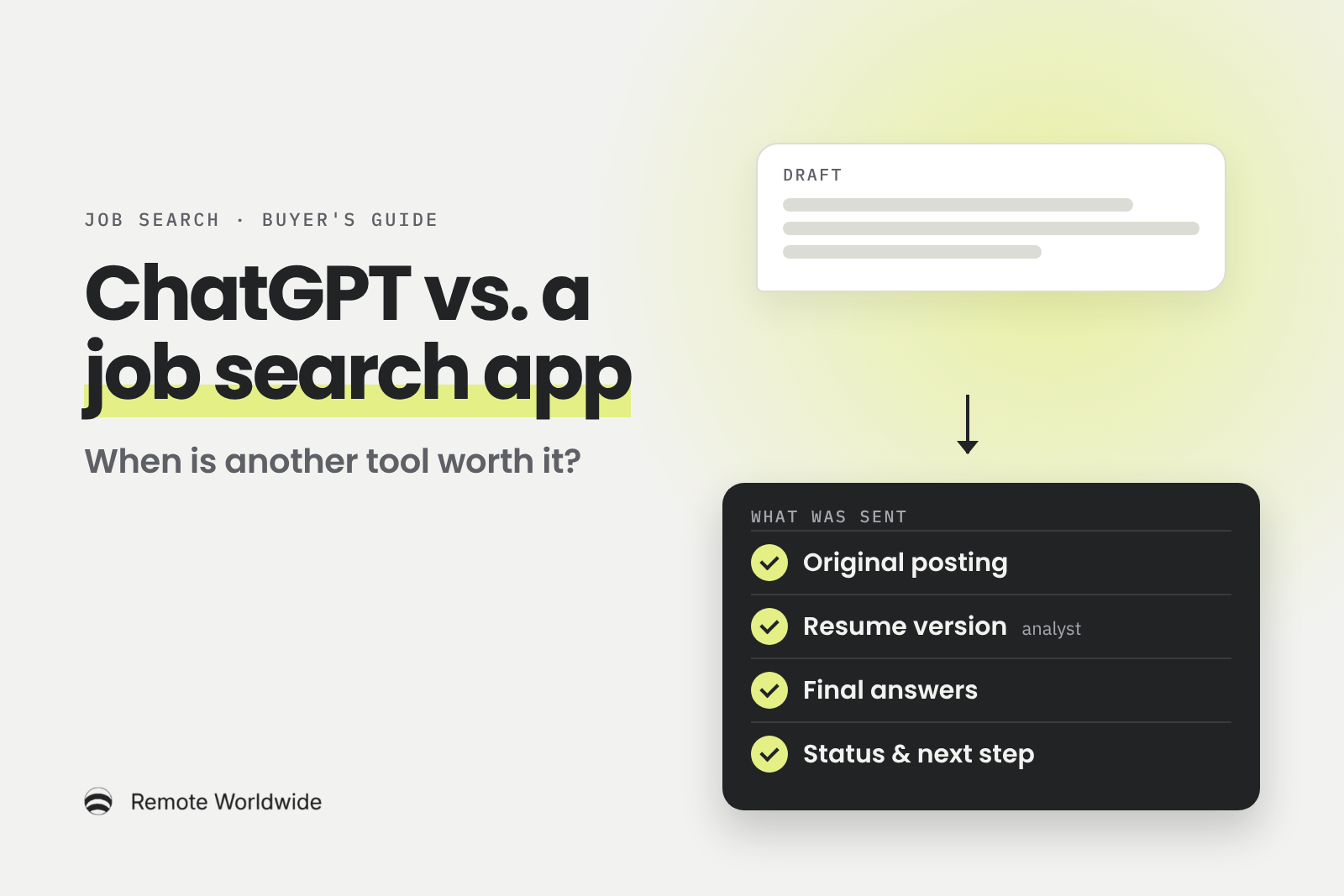
If ChatGPT already handles your resume edits, application answers and interview prep, you don't need another tool by default. A dedicated platform is worth adding when it takes over work you're still doing by hand: keeping the posting, filling forms, recording what you sent, and finding it all again when an interview invitation arrives.
That leaves three sensible choices. Keep a setup that already works. Add RWW's free features to fix one recurring problem. Or pay for a capability you've tried and found useful.
This scenario is fictional and illustrative.
Marisol has six years in operations at an e-commerce fulfillment company. She led nine coordinators, built carrier-performance reports in Google Sheets and wrote the returns procedures. She uses basic SQL but has never owned a data pipeline.
She applies for three roles that weigh that experience differently. The Operations Manager role wants team leadership and procedures. The Business Operations Analyst role wants reporting and analysis. The Customer Operations Lead role wants support workflows and service metrics. Eight days later, the analyst role invites her to interview.
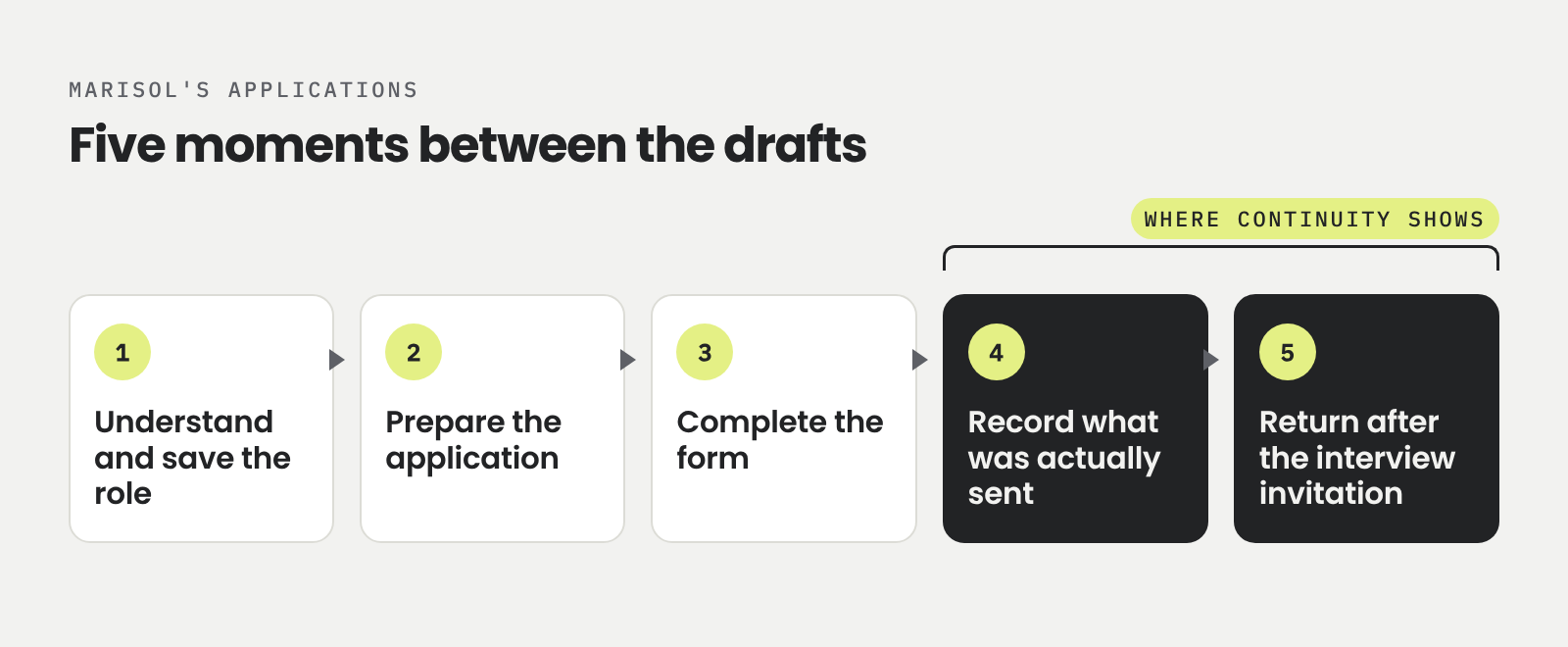 1. Understand and save the role
ChatGPT: Marisol saves each full posting as a source in her project, labeled as the original, and keeps ChatGPT's summary as a separate file. Later project chats can draw on both. Keeping them apart matters: an AI summary isn't the employer's posting, and she'll want the exact wording later.
RWW: She imports each posting from a link or pasted text, free, and it becomes a saved job she can come back to. Ask about a job answers questions using the posting and her profile. RWW doesn't say whether the full text stays available if the employer removes the listing, so she keeps her own copy in either setup.
Each role needs different evidence. The analyst version leads with her carrier reports; the manager version leads with her team and procedures. Our tailoring guide covers the method.
Whichever tool she uses, Marisol rejects wording that turns basic SQL queries into dashboard or data-pipeline experience.
ChatGPT: Drafts work from her project files. The instruction to stick to verified facts helps, but it doesn't guarantee accuracy, so she reviews each draft. She saves each approved resume under a clear name and notes in her sheet which version went where.
RWW: The resume builder tailors to the saved posting and lists keywords it can't find in her resume, and she ticks only the ones that are true. The ATS checker scores the match, but that score is RWW's estimate, not an employer's screening decision. Free includes one resume in the builder. Basic supports multiple resumes, which matters if she wants to keep separate versions for different roles inside RWW.
Drafting an answer, filling a form and submitting an application are separate steps. Our guide to application questions covers the writing.
ChatGPT: On any plan, she can paste her answers into the form. On eligible paid plans (not Free or Go), ChatGPT Work's cloud browser can enter information on supported sites for her. OpenAI says it asks for confirmation before hard-to-reverse actions, and that some sites block automated browsers.
RWW: The Chrome extension fills forms from her profile and saved answers when she presses a button, so she doesn't retype answers she's already approved. It supports Greenhouse, Lever and Ashby out of the box. She can add another careers site with a Chrome permission, though that doesn't prove every form there will work. It drafts answers to new questions for credits, keeps unfinished applications as drafts and never submits.
Either way, a filled form isn't a submitted application. Marisol reviews every field and clicks submit herself.
A chat full of drafts doesn't show what the employer received.
ChatGPT: Marisol adds a row for each application: role, date, saved posting, resume file, final answers, status and next step. ChatGPT can help her update it, but the record is only as current as she keeps it.
RWW: When she submits through the extension, the application is tracked and the answers from her draft join its record. Applications finished in RWW's apply wizard arrive with the resume, score and cover letter used. She still adds applications sent other ways, such as by email, and she moves each one to later stages herself. The tracker schedules follow-up reminders and drafts the messages, but nothing is sent for her.
In both setups, the same habit applies: after each application, check the record rather than assuming it captured everything. Our tracking guide covers what a good record holds.
This is the real test. Eight days later, can Marisol pull up the analyst posting, the resume she actually submitted and her final answers before she starts preparing?
ChatGPT: Yes, if she kept step 4 up to date. The sheet names the resume version, and the project holds the original posting and her final answers. She asks for likely questions and practices with Voice inside the project, and a transcript is added to the chat for review. Voice limits vary by plan. OpenAI notes transcripts may not be verbatim, and it doesn't document an analysis of pauses or filler words. That doesn't mean one is impossible, only that she shouldn't count on it.
RWW: The application is already on her board with the materials it captured. The voice mock interview writes questions from the posting and her resume, records the session and returns scores, per-question feedback, a transcript and a delivery report on pace, pauses, filler words and pitch. Free includes one session a month. RWW says interview prep syncs with the tracker but doesn't document how a session chooses the posting or resume version, so she should confirm it's using the analyst role.
In both setups, scores and feedback are review aids. They aren't a hiring decision or proof that she's ready. For more, see solo interview practice and AI mock interview tools.
Stay on top of it
A board for every application, follow-up reminders, and a streak that keeps the search moving.
Track my applicationsKeep your setup if you already store postings, resume versions and final answers together and update your tracker as you apply. The same goes if you mostly apply by email, referral or on sites the extension doesn't support. If step 5 would go smoothly for you today, your setup works.
Try RWW free when one problem keeps coming back:
Use both if ChatGPT is where you research companies or work through your stories. Choose one place for final materials and statuses. Explore in ChatGPT, put the approved answer in the form, and let RWW hold the record. Keeping two trackers creates another record to maintain. Both free plans can cover this split.
Adding a free RWW account isn't buying a subscription. If you already pay for ChatGPT for other work, RWW would be an additional cost, not a replacement, so ask whether it adds enough. In this scenario, the relevant paid difference on ChatGPT is Work's cloud browser.
On RWW, credits and feature caps are separate. Free includes 45 AI credits a month, which pay for actions such as ATS scans or questions about a job. Caps limit specific features regardless of credits: Free includes one resume in the builder and one voice interview a month, and unused credits don't lift either cap.
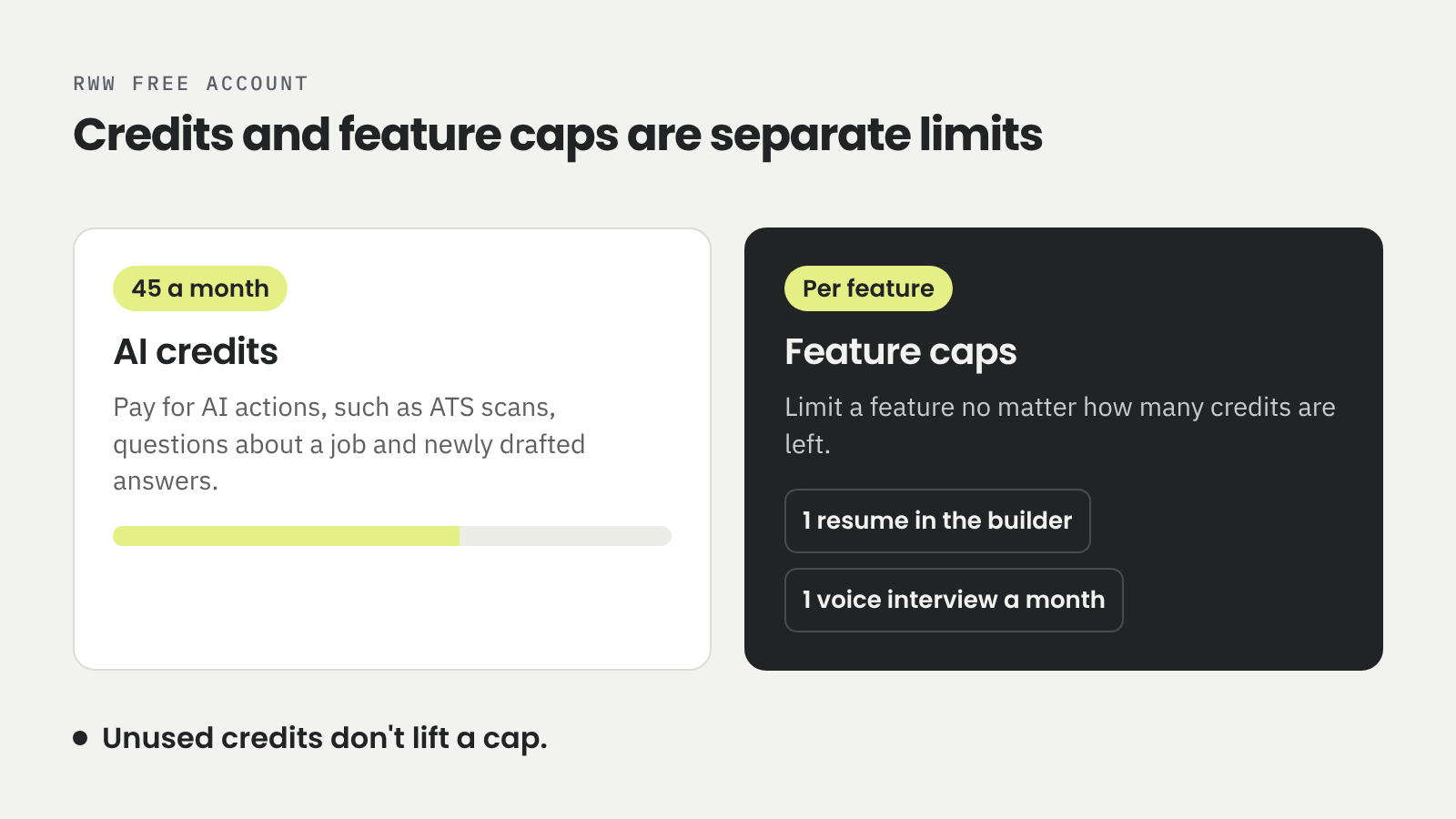
So start with the recurring problem, try the relevant feature free, and pay only when the benefit justifies the cost. If you want to keep several resumes inside RWW, Basic supports multiple resumes. If one voice interview a month isn't enough, Pro expands interview practice. Check current prices on RWW's pricing page and OpenAI's.
Stay on top of it
A board for every application, follow-up reminders, and a streak that keeps the search moving.
Track my applicationsBoth setups mean sending your resume, and possibly your voice, to AI services. Review ChatGPT's Data controls and the retention rules for the voice mode you use. Conversation content and audio recordings are handled separately, so check the settings for each before uploading or recording.
RWW's privacy policy names its AI providers, including ElevenLabs for voice. Deleting a session in RWW doesn't necessarily delete copies held by its voice provider.
Either way, share only what the task needs and leave out confidential employer or client information.
Pick a role you're applying for. Save the posting, apply through the extension if the form is supported, then come back a few days later and ask: Can I see what I sent, where the application stands, and what I need to do next? That's a more useful test than whether another tool can generate another paragraph.
Create your free RemoteWorldwide account and try it with one role you're applying for.
Disclosure: RemoteWorldwide (RWW) publishes this guide and is the platform compared here. The comparison is based on OpenAI's and RWW's official documentation.
Stay on top of it
A board for every application, follow-up reminders, and a streak that keeps the search moving.
Track my applications
One fictional applicant, several worked answers: how to turn real experience into application answers a reader can check.
Theophilus OyetiOct 29, 2026
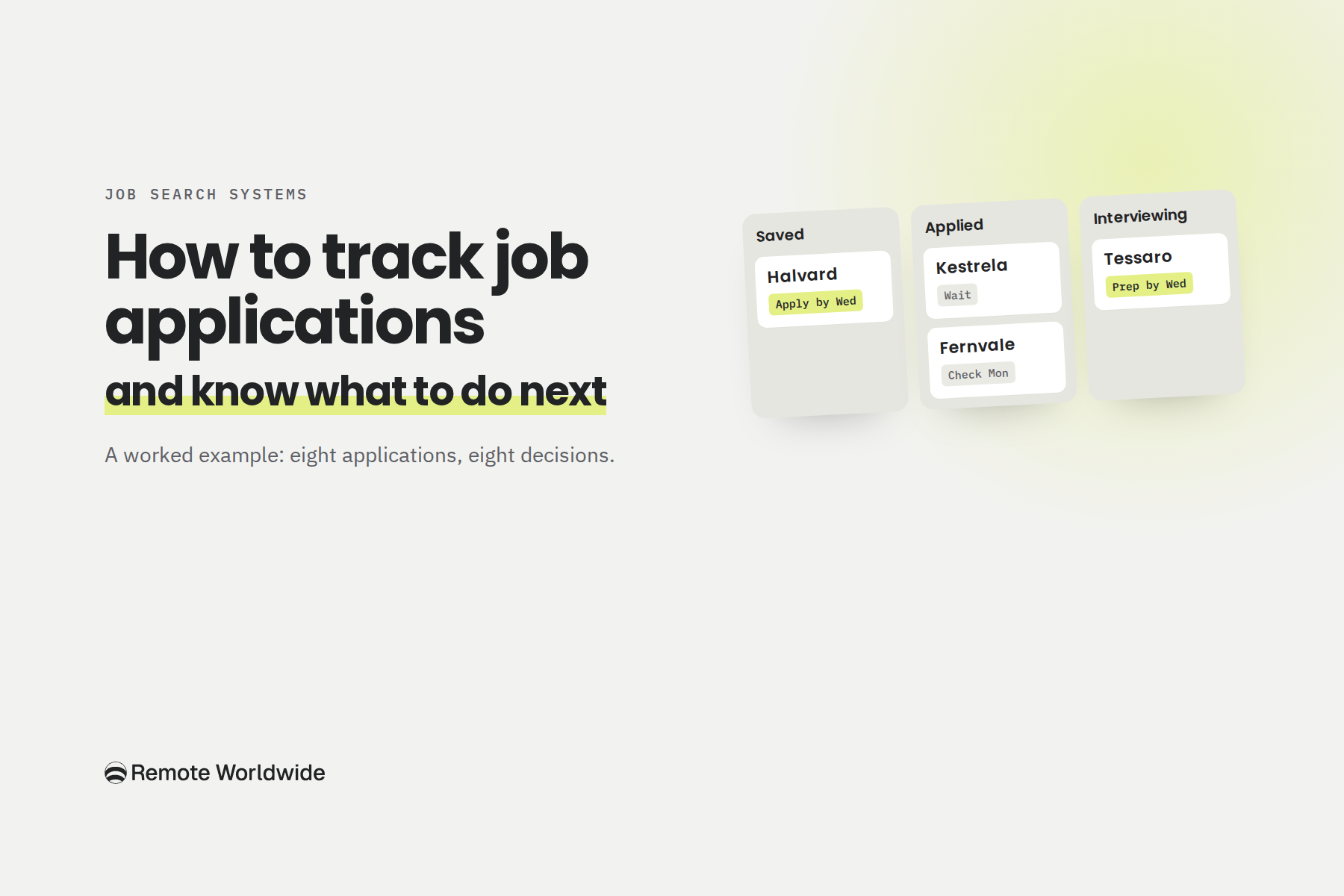
Several applications, several decisions: a simple tracker that tells you what to do next.
Theophilus OyetiOct 21, 2026
Five AI mock interview tools compared on practice format, follow-ups, feedback, free limits and price.
Theophilus OyetiNov 1, 2026