Job search
How to Answer Job Application Questions and Stand Out (With Examples)
One fictional applicant, several worked answers: how to turn real experience into application answers a reader can check.
Theophilus OyetiOct 29, 2026
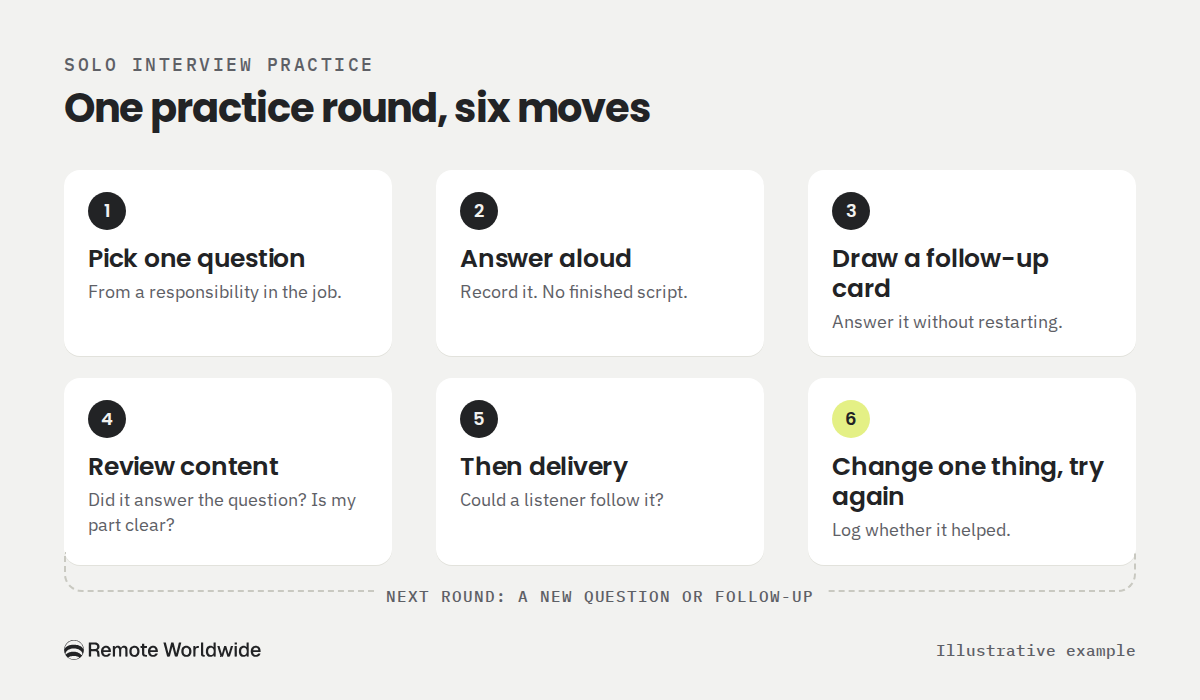
One practice round, start to finish: answer aloud, draw a follow-up, review what you said and change one thing.
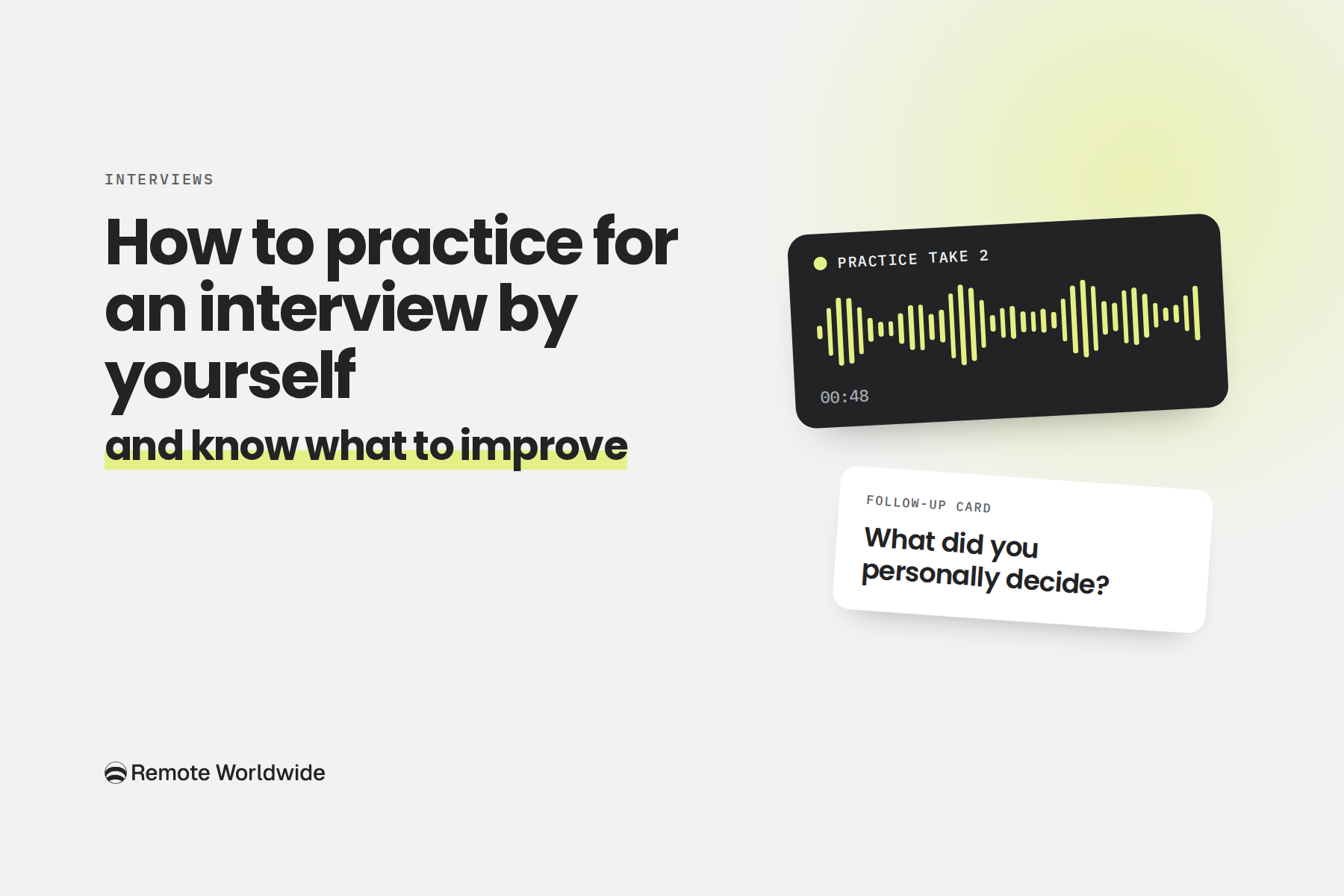
You've read the advice and thought about your answers. But you don't know how they sound out loud, and nobody's around to rehearse with.
Here's how to practice for an interview by yourself. Choose a few questions that come from the actual role. Answer one aloud, with no script, and record it. Then answer a follow-up. Play it back and check what the answer communicated before you judge how it sounded. Pick one change, try again, and check whether that change helped.
That's the whole method. The rest of this article walks through one practice round with a fictional candidate, so you can see what "check" and "one change" look like. It focuses on experience-based questions and complements company research and any technical, case or portfolio preparation the role needs.
Amara is applying for a junior marketing coordinator role. She and the employer are fictional.
The job (excerpt)
Plan and publish posts across our social channels on a consistent schedule. Work with designers and subject experts to get content approved on time. Track engagement and share what's working.
Amara's notes
Start with the role, not a list of 50 common questions. Manchester's careers service suggests reviewing the job description and your application before an interview, and being ready to expand on examples you've already given (University of Manchester).
Amara turns each responsibility into one practice question:
| Responsibility | Practice question |
|---|---|
| Consistent schedule | Tell me about a time you improved how content was planned or published. |
| Approvals on time | Describe a time you needed sign-off from someone with very little time. |
| Tracking what works | How have you judged whether your content was working? |
These are practice questions, not a prediction of what the employer will ask. They give her a reason to talk about each part of the job. She practices the first one fully today.
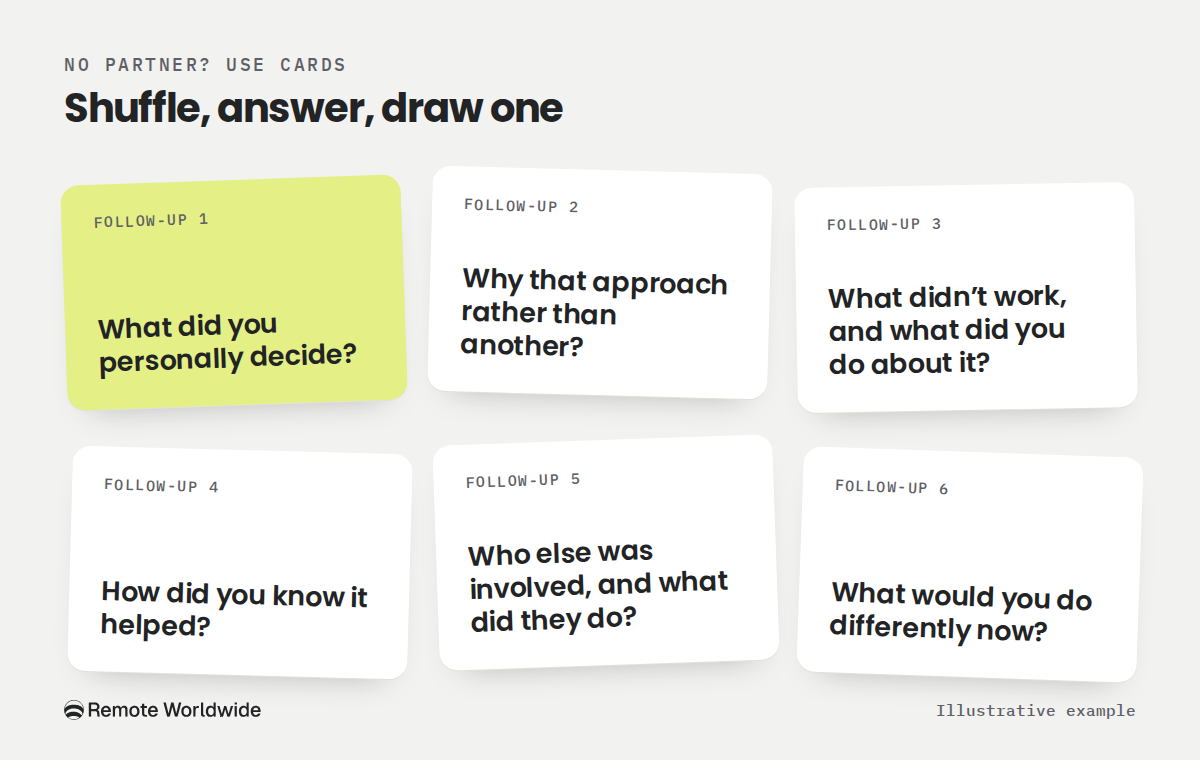
Before she starts, Amara writes six follow-up questions on cards (the full list is below) so she can draw one after answering. Then she presses record on her phone and answers without reading a finished script
First attempt
Sure. So I volunteer with a community food bank near me, and I've been doing their social media for about eight months. Before I started, posts about the Saturday shifts kind of went out whenever someone had time, sometimes the night before, and Saturdays were often short of volunteers. So we worked on making the posting more organized. We set up a shared calendar, we posted more regularly on Instagram and in the neighborhood Facebook group, and things got a lot more consistent. Another volunteer took the photos, and the coordinator approved everything. And it went really well. Saturdays were fully staffed in two of the next three months, which hadn't happened in the three months before, so that was a good result.
That's a reasonable answer. The context is clear, she credits other people, and the outcome is concrete. Now she draws a follow-up card (more on those below).
Follow-up card: What did you personally decide?
Oh, the schedule was my idea. I suggested a shift post every Tuesday and a reminder on Fridays. And I suggested we stop posting on X, because hardly anyone replied there, and the coordinator only had about an hour a week to approve things.
Play the recording back and compare it with the question.
What the question asked: how she improved the way content was planned or published.
What the first answer supplied: the problem, what the team did, who helped and the result.
What stayed unclear: what Amara decided. She said "we" throughout, and "So we worked on making the posting more organized" and "we posted more regularly" describe the team's activity, not her choices.
What the follow-up revealed: two real decisions, a fixed Tuesday-and-Friday schedule and dropping X, plus a reason tied to a real constraint. That’s the most relevant part of her experience for this role, and it only came out after she drew the follow-up card.
The one change: say what she decided, and why, before describing the result.
That's more useful than "be more confident" or "add impact," because she can act on it in the next two minutes. Other things could be polished too. One change at a time makes it possible to tell whether it worked.
Amara writes a few reminders she can glance at before trying again:
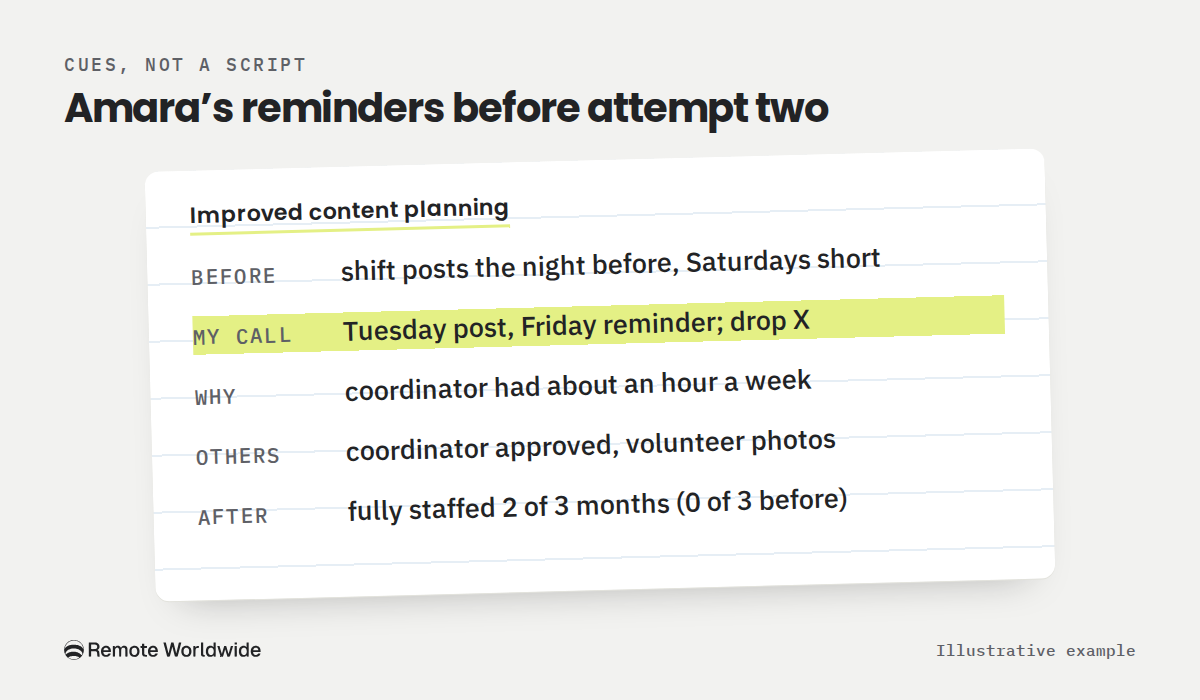
Writing things down is fine. The difference is what the notes do. Cues help you organize experience so you can find it while talking. If you depend on exact wording, a question phrased differently or an unexpected follow-up can leave you hunting for the next line instead of thinking about your answer. Harvard's career center notes that practicing doesn't mean memorizing answers (Harvard Mignone Center for Career Success).
Same question, same facts, second attempt:
I volunteer with a community food bank, and I've run their social media for about eight months. When I started, posts about Saturday shifts went out whenever someone had time, often the night before, and Saturdays were regularly short of volunteers. I made two changes. First, I proposed a fixed schedule, a shift post every Tuesday and a reminder every Friday, planned in a shared calendar. Second, I suggested we stop posting on X, where almost no one replied, and focus on Instagram and the neighborhood Facebook group. The coordinator only had about an hour a week to approve posts, so fewer channels meant faster approvals. She approved everything, and another volunteer took the photos. Saturdays were fully staffed in two of the next three months, compared with none of the previous three.
A different follow-up card: How did you know it helped?
I can't be completely sure. A flyer went up at the library the same month. But on the sign-up form, where people say how they heard about us, more answers named Instagram or the Facebook group. We didn't have link tracking, so that was the best evidence I had.
What improved: a listener can now say what Amara decided and why without having to ask. The facts haven't changed. She explained the same experience differently.
What to practice next: her follow-up response did its job. It added depth without claiming the posts caused the whole improvement, and an opening answer doesn't need to carry every limitation. Her next exercise is to explain that evidence clearly whenever she's asked how she knows, still without overstating cause. That's a new target, separate from whether today's change worked.
Practice out loud
Practise the questions this company actually asks, get scored on your answers, and walk in prepared.
Start practisingYou can use the same check on any recording. Mark each question clear, needs work or not applicable.
Don't add up a score. The point is to find the one change worth making next.
Amara's log entry
Blank log for your own practice
Review content first, then play the recording again and listen for whether someone could follow it:
Amara's example is written, so it can only show a content review. Your recording will tell you about your own delivery. The aim is to be easy to follow. You don't need a particular speed, zero filler words or a different accent, and a pause to think isn't a flaw.
This is a convenient time budget, not a proven formula:
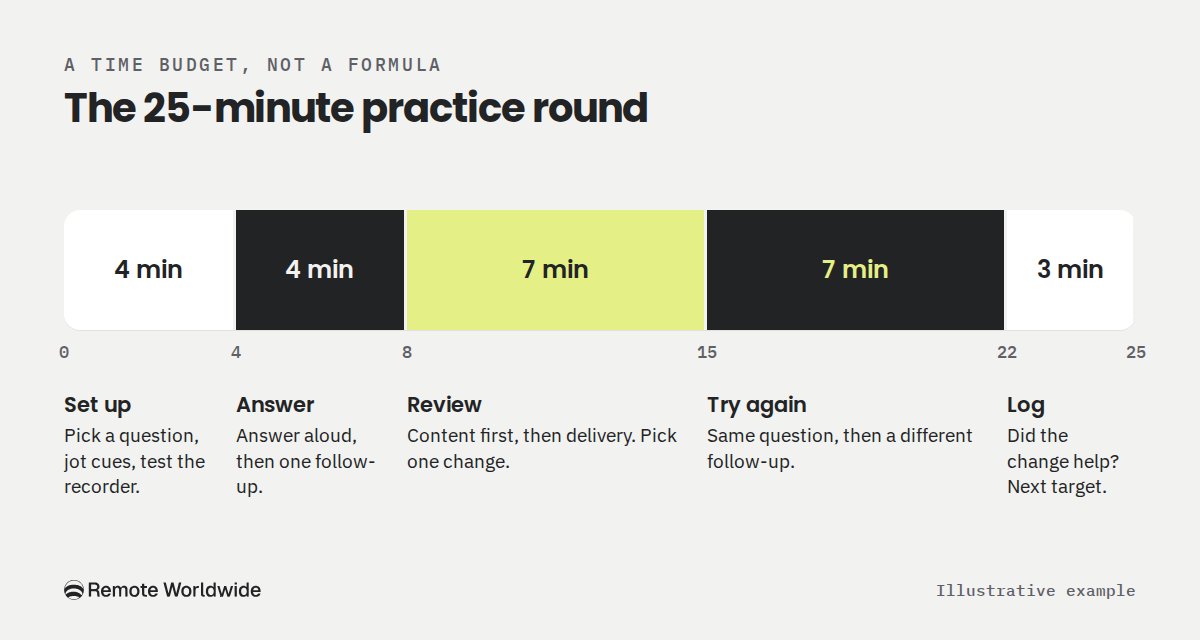
Stop there. You should have a note on whether the change helped, one remaining issue and a next target. Sometimes the honest result is "no clear improvement yet," and that's still useful information. Once you've tested a change, vary the question or the follow-up next time instead of rerecording the same answer until it sounds perfect, so you practice using your experience rather than repeating wording.
Write a few follow-up prompts on cards or slips of paper. After each answer, shuffle them and draw one:
Cards add variety, but they can't listen and adapt the way a person can. Some cards won't fit your answer. Draw again when that happens.
Pause, say something like "Let me put that another way," and carry on. You'll need to recover in a real interview too, so practice that instead of restarting the recording every time.
Some gaps can't be fixed by saying an answer more smoothly. Suppose Amara practices her third question, about judging whether content worked, and a follow-up asks which engagement numbers she'd track. If the sign-up form is the only measure she has used, repeating her answer more smoothly won't help. She needs to learn the basics of the analytics the job is likely to use, and be clear about what she has and hasn't done.
The same goes for anything on your resume you can't explain in detail. Go back to the resume and written application answers you actually submitted, and make sure you can support each claim. Tailoring your resume to the job description covers keeping those claims accurate. It also helps to keep your practice notes and log with that application, as in our guide to tracking job applications.
In a one-way video interview there's no live follow-up. You answer prompts on screen within limits the employer sets, and the employer decides whether you can retake an answer. Harvard's career center advises allowing enough time to finish in one sitting and practicing on the specific platform beforehand (Harvard Mignone Center for Career Success).
Read the employer's instructions first. Time your practice answers to their limit, practice getting to your point early, and treat each recording as final unless they've said retakes are allowed.
An AI tool can ask questions and follow-ups for you, but it's optional, and it isn't the judge. Check the employer's rules first, because attitudes to AI vary, and Manchester's careers service advises against using AI during the interview itself (University of Manchester). This is for preparing beforehand.
For a longer optional session than the 25-minute round, try an instruction like this:
Act as an interviewer for this role. Use only the job description
and experience notes below.

Job description: [paste]
My experience notes: [paste facts, not finished answers]

Run three rounds. In each round:
1. Ask one main question, then stop and wait for my answer.
2. Ask one follow-up based on what I actually said, then stop
   and wait for my answer.

Give no feedback until all three rounds are finished. Then:
- Quote my words when you point out a weakness.
- Suggest one improvement to work on first.
- Don't write a model answer, invent experience I didn't mention,
  or predict whether I'd be hired.
- If you only have my typed text, don't comment on my voice
  or delivery.
Typing your answers helps with content, but you still need to speak them aloud to practice delivery. Not every tool can hear audio or produce an accurate transcript.
Compare the feedback with what you actually said. AI can be inaccurate, and its suggestions should be ideas, not a script that replaces your own experience (Harvard Mignone Center for Career Success). Ignore feedback that invents an achievement, misreads your role or asks for polish the question doesn't need.
Protect what you share. Tools have different data policies, so anonymize what you can (University of Manchester):
The method above works with a phone and a few cards. What takes effort is playing interviewer and reviewer at the same time.
RemoteWorldwide's mock interviews take on the interviewer's part. A voice interviewer asks questions based on the job posting and your resume, and can follow up when an answer is vague. The session is recorded with a synced transcript, and the report gives feedback on your answers, backed by quotes from what you said, and on your delivery. That gives you material to review instead of starting from a blank page.
You still decide what to change. Scores and delivery measures are prompts for your own review, not a hiring decision or proof you're ready. Mock interviews are a paid-plan feature and are opening to early users in batches. The remote job board is free.
Visit RemoteWorldwide to explore mock interviews and become an early user.
.
Practice out loud
Practise the questions this company actually asks, get scored on your answers, and walk in prepared.
Start practising
One fictional applicant, several worked answers: how to turn real experience into application answers a reader can check.
Theophilus OyetiOct 29, 2026
Several applications, several decisions: a simple tracker that tells you what to do next.
Theophilus OyetiOct 21, 2026
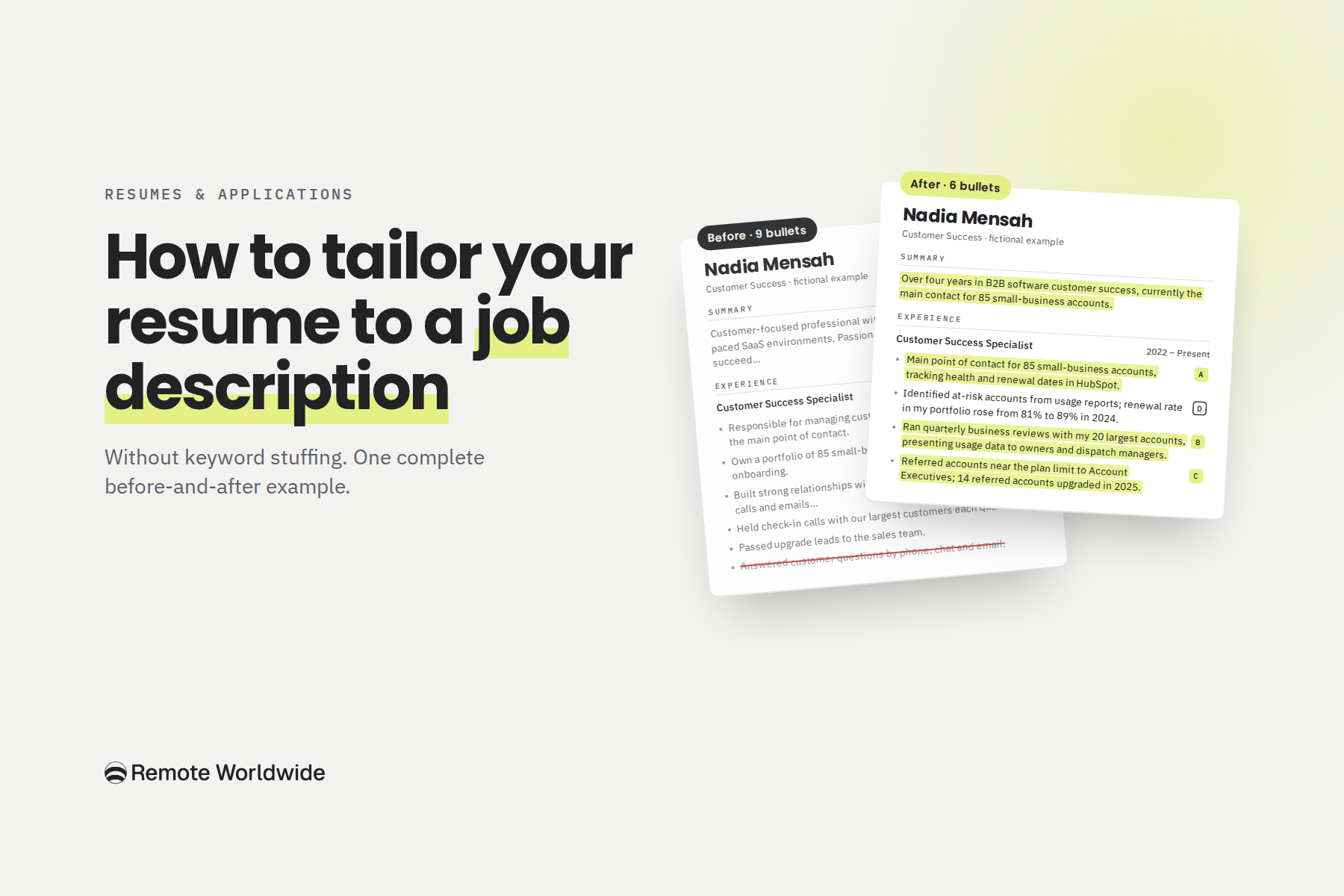
One job ad, one resume, every edit explained, including the changes you shouldn't make.
Theophilus OyetiOct 20, 2026