I spent more than 18 months preparing for customer success interviews. Each time a company invited me to talk, I opened my notes app, researched the company and wrote out how I'd answer what I expected them to ask. By the end I had pages of it.
Rereading those notes for this article, two things stood out. The answers that held up were about one specific customer and what I actually did. The weak ones leaned on phrases like “strong relationships” and “data-driven” and could have come from anyone.
This guide is the edited version of those notes: 23 questions, how I'd approach each one, and a complete sample answer. It can't promise you an offer. It should help you explain a real customer problem, your part in solving it and the evidence behind the result.
Every sample answer carries one of two labels:
- Experience example: edited from the interview-preparation notes I wrote during that period, with anything that would identify a customer removed. These reflect my work at that time. They aren't word-for-word interview transcripts or a full description of my current role.
- Sample approach: how I'd answer an opinion or hypothetical question. It describes a plan, not something that happened.
In this guide
- Before you write answers, research this role
- How to structure answers about your experience
- You and the role (questions 1–4)
- Onboarding and first value (questions 5–7)
- Risk, retention and escalations (questions 8–13)
- Metrics, growth and scale (questions 14–18)
- Judgment and ways of working (questions 19–22)
- Optional: leading a project or team (question 23)
- A practice case
- Questions to ask the employer
- Practice it out loud
Before you write answers, research this role
“Customer Success Manager” describes very different jobs. One company's CSM runs onboarding for a handful of large accounts. Another's looks after thousands of small ones through email and webinars. The word “manager” usually refers to managing customer relationships, and many of these roles have no direct reports.
Before you prepare a single answer, find out:
- Buyers and users: who buys the product, who uses it day to day, and what each group needs from it.
- Customer segment: consumers, small businesses, mid-market or enterprise.
- Portfolio: roughly how many accounts, and whether they're named accounts or a shared pool.
- Lifecycle: which parts you'd own, from handover and onboarding through adoption, reviews and renewal.
- Product complexity: whether customers set it up in an afternoon or over a multi-week implementation.
- Technical expectations: whether you'd explain the product, troubleshoot integrations or work alongside a solutions engineer.
- Commercial ownership: who runs renewals, expansion and any negotiation.
- Success measures: what the team is judged on, and what you'd be judged on.
- Direct reports: whether the role manages people.
Companies split this work differently. GitLab's public handbook, for example, describes CSMs who own success plans and business reviews while sharing responsibility for renewals with account executives and a renewals team (GitLab CSM handbook). That's one company's model. The posting and the recruiter will tell you what applies here, and your examples should match it. Use the company's current information too. Notes you made about an employer a year ago may be out of date.
How to structure answers about your experience
For “Tell me about a time…” questions I use three parts:
- Situation: the context, what the customer needed, and what you were responsible for achieving.
- Action: what you decided and did, with credit to the people who worked on it with you.
- Result: what happened, and the evidence you have for it.
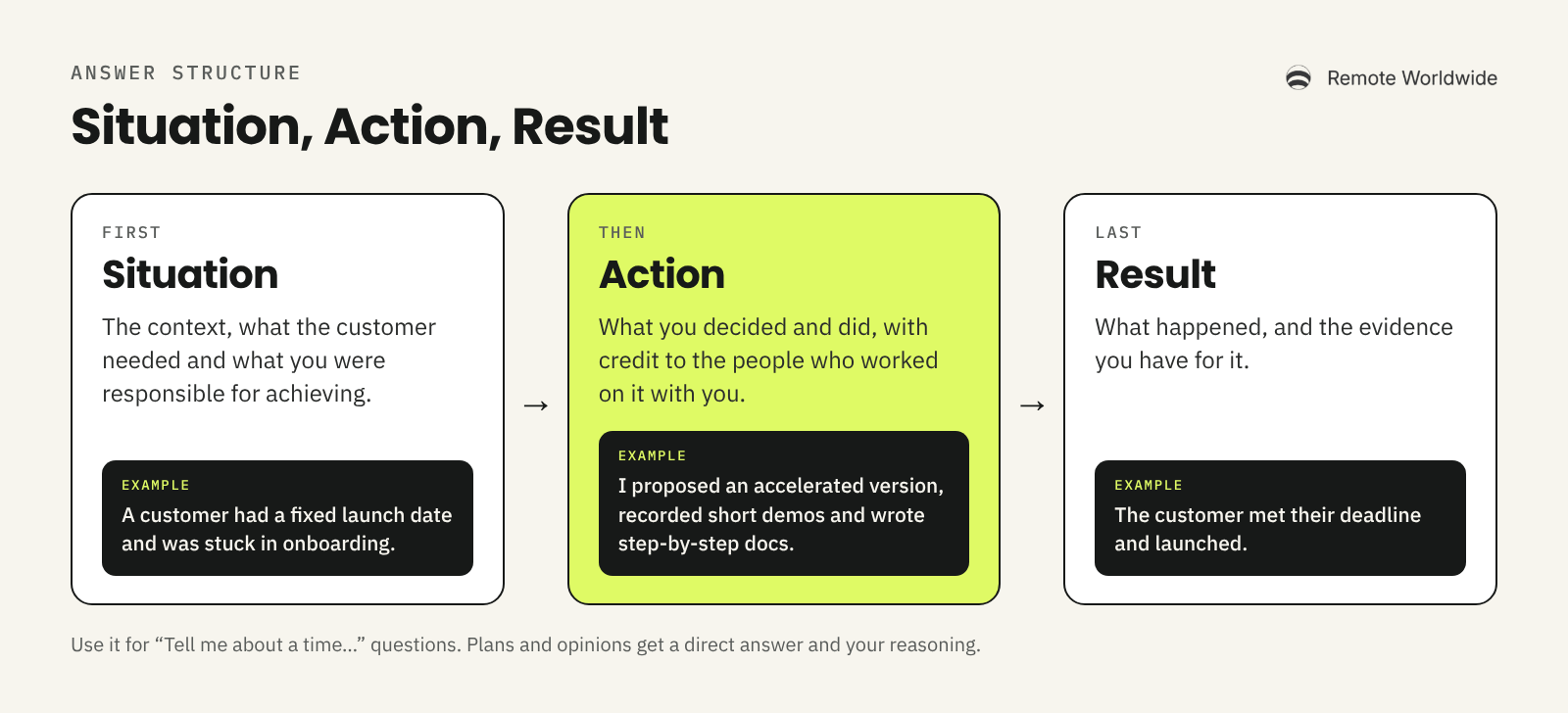
You can open with one sentence that sums up the story before you tell it. That's optional. In the interview, don't announce the labels; just tell it in that order. Our general interview guide covers the structure in more detail.
Definitions, motivation, first-30-day plans and hypothetical cases are different. They need a direct answer and your reasoning. Don't attach an invented result to a plan. And if you're asked for a past example you don't have, say so and offer the closest thing you've done.
You and the role
1. Tell me about yourself
How to approach it: Go from where you started to the role you're describing, then why you're here, in under two minutes. Name your customer segment and the size of your portfolio so the interviewer can place you. Keep to things you could expand on if asked.
Experience example:
I started in customer service at a small logistics business, which is where I found that solving problems for customers was the part of the job I liked most. That led me into customer success at SearchSmartly, a real estate technology company. In that role I looked after around 80 small and mid-sized business customers. My focus was aligning our product with each customer's goals, guiding them through onboarding so they reached their first real use of it quickly, and working with Product and Engineering when something blocked them. That mix of customer relationships, onboarding and practical problem-solving is the work I want to keep doing, which is why I'm interested in this role.
Follow-up to practice: “What were you measured on?” Name the measures that actually applied to your role.
2. Why do you want to work here?
How to approach it: Give one thing about the company you've checked and one honest connection to your own experience. A personal reason is fine if it's true. Leave out praise that would fit any employer.
Experience example (prepared for a company that helps businesses employ people in other countries):
Two reasons. Your founder has said the company exists because talent is everywhere but opportunity isn't, and that's personal for me. I've seen how hard it is to get hired internationally when many companies won't consider candidates outside their region. Helping businesses hire across borders is a problem I'd like to work on. The second reason is the role. The posting describes onboarding and educating a large number of smaller customers, which is work I know and want to keep getting better at.
Make it yours: Look for the link that's real. When I prepared for a construction-software company, mine was that I studied construction management. If you can't find a personal one, name the specific part of the role that matches your experience.
3. How do you define customer success?
How to approach it: Start with the customer's outcome, then say what it means for the business. If you mention Support, describe how the two teams work together. Keep it short; the follow-up matters more.
Sample approach:
Customer success is making sure customers get the outcome they bought the product for. In practice that means understanding what the customer is trying to achieve, checking that they're using the product in a way that gets them there, and acting on a problem before it becomes a reason to leave. Support and customer success work closely on this. Support resolves the issues customers raise and often spots patterns first. Customer success follows the customer's progress toward their goal over time. When that works, the business sees it as renewals and growth, but the customer's result comes first.
Follow-up to practice: “How would you know a customer is successful?” Have one concrete sign ready that isn't just logins.
4. What types of customers have you worked with?
How to approach it: Be specific about segment, numbers and what those customers needed from you. If you've worked with different kinds of customers, keep them separate so the interviewer can follow which experience belongs to which group.
Experience example:
Different groups, and they needed different things from me. Earlier in my career I supported individual consumers who were searching for a home. They needed quick, clear answers, and many were new to the process. In customer success I worked with small and mid-sized businesses in real estate, a portfolio of around 80 accounts, where the conversations were about onboarding, adoption and whether the product was doing what they'd bought it for. I've also supported customers who built our API into their own websites and products, which meant coordinating with our technical teams when they hit a problem.
Follow-up to practice: “What was the largest account or portfolio you managed?” Know the figure, the currency and whether it covers your whole book, so you can explain it.
Onboarding and first value
5. How would you structure a customer's onboarding?
How to approach it: Start from the customer's outcome and the people involved, not from a fixed list of meetings. Say how you'd know it's working. If you're asked what you've actually done, use a real example like the one in question 6.
Sample approach:
I'd start with the outcome: what does this customer want to be able to do, and by when? Then the people. Who is responsible for setting the product up, who will use it day to day, and do they know why it was bought? Next I'd ask what could hold things up, such as data that needs moving, an integration or a busy period on their side. From there we'd agree on a first useful milestone, something the customer can actually do with the product, and who is doing what before we next speak. I'd judge onboarding by whether they reach that milestone, not by how many sessions we held.
Follow-up to practice: “What would you do if they missed the first milestone?”
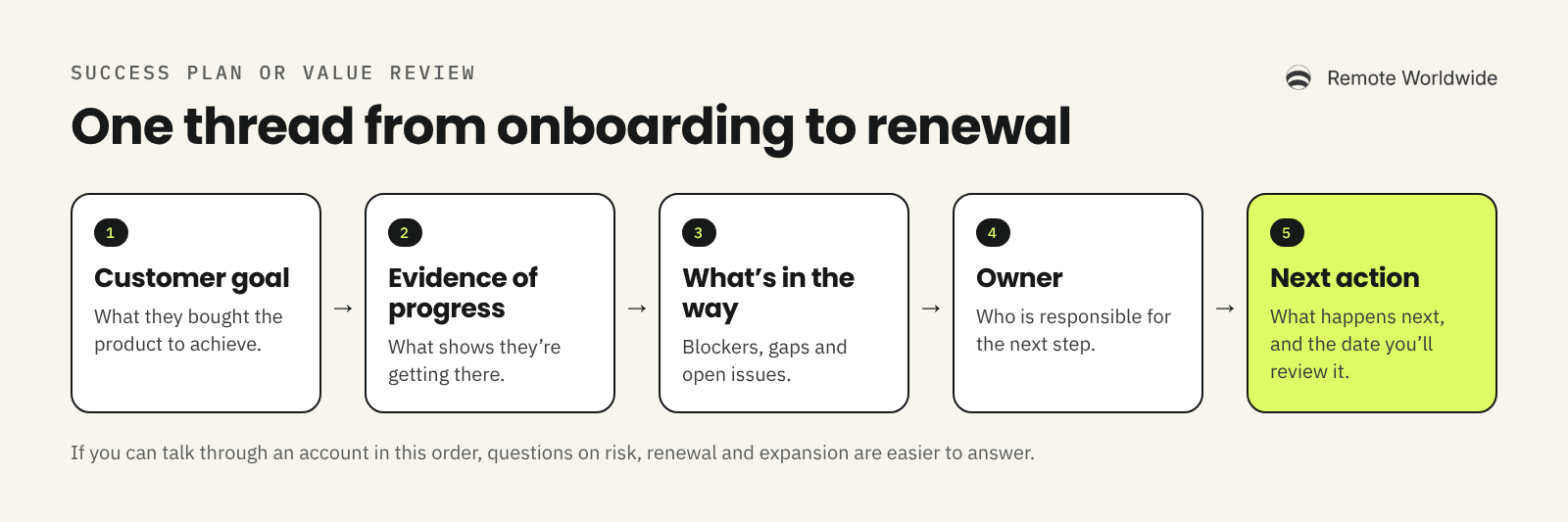
Keep one thread from onboarding to renewal. A simple success plan, or a regular value review, connects five things: the customer's goal, the evidence of progress toward it, what's in the way, who owns the next step, and the next action with a date to review it. If you can talk through an account in that order, the questions on risk, renewal and expansion below become easier to answer.
6. Tell me about a time you had to change your usual approach for a customer
How to approach it: Say why the standard process wouldn't work, what you changed, what you made and the result. This story can also answer “a creative solution” or “a time you went above and beyond,” so use it once per interview.
Experience example:
A customer was building a new product on top of our API and had a fixed launch date, but they were having difficulty with our onboarding process. The usual onboarding wasn't going to work for them in the time they had. I proposed a tailored, accelerated version that focused on the most critical steps. I recorded short Loom videos demonstrating each of those steps, wrote step-by-step documentation in Notion, and gave them personal guidance and support as they worked through it. The customer met their deadline and launched.
Follow-up to practice: “What did you leave out, and how did you decide?”
7. What's something you've learned recently that you'd apply here?
How to approach it: Pick an idea that would change what you do, say where it came from and how you'd use it in this role. Be accurate about whether it's something you've read or something you've put into practice.
Sample approach:
I've been reading about deployment discovery. The idea is that the person who buys software and the people who set it up are often different, and the people doing the setup may have little context on why it was bought or what it's meant to improve. When that happens, onboarding can drag, and the longer a customer waits to see value, the greater the risk to the account. It would shape how I handle a handover here. I'd ask two questions early: who will actually implement this, and what have they been told about why? If the answers are vague, I'd close that gap before the first training session.
Make it yours: Choose something you've actually read or been taught, and say how you'd check whether it works in this company.
Risk, retention and escalations
8. How do you spot an account that's at risk, and what do you do?
How to approach it: Name the signals you watched. Treat a signal as a reason to ask the customer, not as a diagnosis. Then say what you did and what changed. Keep “at risk” separate from “churned” when you describe the result.
Experience example:
I monitored product usage and adoption, and I watched for early warning signs such as a drop in usage or slower replies. With one key client, I noticed engagement declining. I reached out and found they were struggling with a particular feature. I worked with our product team on a solution suited to how they worked, then gave them a personalized training session using Loom. The client saw an immediate improvement and went on to expand their use of the product.
Follow-up to practice: “What would have changed your first explanation?” Say what you'd rule out before acting, such as a holiday period or a change in their team.
9. How would you reduce churn here?
How to approach it: You don't have their data, so don't prescribe a fix. Say what you'd look at, in what order, and how you'd know whether a change worked.
Sample approach:
I don't know your numbers yet, so I'd start by finding out where customers are being lost: during onboarding, after a quiet period or at renewal. Then I'd compare your most settled customers with those who left. What did the first group do in their early months that the second didn't? That gives me possible warning signs to test, not proof of what causes customers to stay. The simplest input is still asking customers who left, or nearly did, why. From there I'd pick one cause, change one thing about how we handle it, and check whether it moves before adding anything else.
Follow-up to practice: “What data would you need?” Ask what they track today, and whether churn means lost customers or lost revenue.
10. How would you approach a customer who is unsure about renewing?
How to approach it: Spotting risk is not the same as managing a renewal decision. Here the customer has a date and a choice to make. Show how you'd find the reason, who you'd involve and how you'd review progress before the deadline. If you're asked for a past example, use a real one.
Sample approach:
I'd start by finding out why they're unsure: whether it's about value, adoption, budget, fit or an unresolved issue. I'd also confirm when the decision has to be made and who is involved in making it. Then I'd go back to what the customer set out to achieve and look honestly at the evidence of progress. For whatever is still open, I'd agree on a realistic plan with the people who can fix it, and I'd work with whoever owns the commercial conversation so we're saying the same thing. I'd set a review point ahead of the deadline to check whether the plan is working. I wouldn't promise a feature that isn't committed, and I wouldn't reach for a discount before I understand the problem.
Follow-up to practice: “What would you do if the customer still decided to leave?”
11. Tell me about a difficult customer situation
How to approach it: Show that you listened first, took ownership and kept the customer informed, and credit the teams you worked with. Describe the outcome you know. A resolved issue and a secured renewal are different results.
Experience example:
A client was frustrated by an issue that followed an API integration with their website and had gone unresolved for weeks. I reached out, apologized for the delay and listened to their concerns before offering anything. I told them I would personally oversee getting it resolved. Then I escalated it internally, coordinated the resolution with the relevant technical teams and kept the customer informed throughout. By being transparent and staying with it, we resolved the issue and regained the customer's trust.
Follow-up to practice: “How did you know it was working again on their side?”
12. How have you supported customers with technical products or integration issues?
How to approach it: Describe the kind of technical work you do with customers. Explain what you handle independently and when you involve a specialist. If you used the escalation story for question 11, use a different example here.
Experience example:
Much of my technical work with customers has been helping them get a product working for their business, and coordinating when something needs a specialist. When we launched a new product and a client had trouble with it, I got on a call and guided them through it step by step, explaining how to use it properly for their business. Afterward I wrote a comprehensive guide to help other clients with similar issues. With customers using our API, my part was understanding the problem from the customer's side, working with our product and development teams on it, and keeping the customer updated until it was resolved.
Follow-up to practice: “Explain what an API is to a non-technical customer in two sentences.”
13. How do you work with Sales, Product and Engineering?
How to approach it: Choose one example that shows what you brought to the other teams and what your role was. Start with the customer problem, state your part plainly and credit the people you worked with.
Experience example:
At SearchSmartly I noticed a communication gap with people using our platform to find a home: they had no easy way to follow their own search. I proposed a dashboard where users could track it themselves, and I led the initiative in collaboration with our Product and Engineering teams. The dashboard let users manage their home search from the viewing-request stage through to submitting an offer. As a result, users could manage their search more easily, and our support team was able to focus on more complex inquiries.
Follow-up to practice: “Which decisions or delivery responsibilities did you personally own?”
Metrics, growth and scale
14. Which customer success metrics matter most to you?
How to approach it: Group metrics by the question each one answers, and say what each can and can't tell you. Then be ready to talk about one you've used and a decision it informed.
Sample approach:
I sort them into groups, because they answer different questions. Feedback measures like NPS and CSAT tell me what customers say. Usage and adoption tell me what they do. Retention tells me what they decided. Alongside those I look at whether a customer has reached the outcome they bought the product for, because none of the others proves that alone. A good survey score from an account that isn't using the product doesn't reassure me, and more logins don't show the customer's business result. Before quoting any figure I'd confirm how it's defined here, which customers it covers and over what period.
Make it yours: Prepare one metric you've actually used and one decision it helped you make.
Added preparation guidance. These definitions are reference material for your preparation.
- NPS asks how likely someone is to recommend you, from 0 to 10. Promoters score 9–10 and detractors 0–6; the score is the percentage of promoters minus the percentage of detractors (Net Promoter System).
- CSAT asks how satisfied a customer is with a product, service or interaction. On a five-point survey using the top-two-box method, the score is the percentage of responses that are 4 or 5. Organizations use other scales and scoring, so check theirs (Qualtrics).
- Gross revenue retention is the share of starting recurring revenue you keep after downgrades and cancellations. Expansion doesn't count toward it (ChartMogul).
- Net revenue retention adds expansion back in, so it can go above 100%. Companies differ on the period they use and on whether returning customers count, so ask (ChartMogul).
A higher NPS does not, by itself, demonstrate lower customer acquisition cost. To make that connection you would need evidence about referrals, the customers acquired through them and what acquisition costs.
15. How do you identify expansion opportunities?
How to approach it: Base expansion on a customer need, not on a usage chart. Be clear about who closes the deal in this company. Spotting an opportunity and closing it are different things, so say which one you did. For reference, an upsell moves a customer to a higher plan and a cross-sell adds another product.
Sample approach:
I start from the customer's goals, not from our price list. Heavy use of a feature tells me where to look, but it isn't a reason to sell. The question is whether the customer has a problem that a higher plan or another product would solve better than what they have now. If so, I raise it during a conversation about their results, using their own numbers. If Sales owns the commercial side, I hand over a clear summary: the need, the evidence and the right contact. If the need isn't there, I leave it. A customer who upgrades without a reason can become a renewal problem later.
Make it yours: If you've found, referred or closed an expansion, tell that story and be exact about which of the three it was.
16. Tell me about an initiative you led
How to approach it: Explain the problem you saw, what you built, how you kept improving it and what changed because of it. A webinar is an output. The interviewer wants the effect.
Experience example:
At SearchSmartly, many of the people using our platform to find a home knew very little about UK rental and mortgage rules, and that kept causing setbacks. I started by identifying the most common knowledge gaps, then ran a series of webinars and wrote knowledge-base content for people with no prior knowledge of UK property rules. I also worked with the support team on a feedback loop, so we could keep improving the content based on what customers told us. The initiative cut the time our support team spent qualifying leads, which let them work more efficiently.
Follow-up to practice: “How did you know it worked?” Separate what you observed from what you assumed.
17. We have thousands of customers and a small budget. How would you support them?
How to approach it: Show how you'd choose what to work on first and how you'd know it helped. A knowledge base, a chatbot or more automation is an option, not automatically the answer.
Sample approach:
With that many customers I'd start with a recurring obstacle affecting one group, say new customers stalling at the same setup step. I'd check what support already exists for it, then choose the smallest useful thing we can maintain. That might be reusable guidance, a short demonstration, a targeted message at the right point in the lifecycle, or a value review that shows customers their progress. Some situations still need a person: a complex onboarding, an important milestone or a conversation about growth. I'd review the change by whether customers get past the obstacle, not by emails delivered or webinar attendance.
Follow-up to practice: “How would you decide which customer group to start with?”
18. How do you prioritize requests, and how often should you check in with customers?
How to approach it: Give the criteria you use. For check-ins, tie the frequency to where the customer is in their lifecycle and to whether you have something useful to say.
Sample approach:
For requests, I look at three things: how urgent it is, how much it affects the customer's ability to get results, and what it takes to resolve. Something blocking a launch comes before a question that can wait a day, whoever asked first. Then I tell each customer when they'll hear from me, so nobody is left guessing. For check-ins, I don't use one schedule. New customers hear from me often, because that's when problems surface. After that I get in touch when there's a reason: a milestone, a change in usage or a renewal coming up. A check-in with nothing to say teaches customers to ignore me.
Follow-up to practice: “What if two urgent requests land together?” Say who you'd inform and what help you'd ask for.
Judgment and ways of working
19. Tell me about a time you failed
How to approach it: Choose a real failure with a real consequence. Say what you misjudged, what it led to, what you did next and what you took from it. Describe the recovery as it was.
Experience example:
During a software rollout for a client, I underestimated the training and support their team would need. As a result, their staff struggled with the new system, which led to delays and frustration. I took responsibility for the oversight and immediately arranged additional training and support resources, which helped get them back on track. The experience taught me to assess a client's needs thoroughly, and shape my approach around them, before a rollout begins.
Follow-up to practice: “What did you change afterward?” Describe a change you actually made.
20. A customer asks for something your product can't do. What do you do?
How to approach it: Show that you find the underlying need, explain the limit clearly and early, and keep a product request separate from a promise. The same approach works for “How do you deliver bad news?”
Sample approach:
I tell them plainly, and early. First I ask what they're trying to achieve, because the request is often one way of solving a problem we can solve differently. If we can't meet the need, I say so, explain what we can do, and where it helps, point them to another tool that covers the gap. I pass the request to Product with the customer's reason attached, and I tell the customer exactly that: it's been passed on, and I can't promise it will be built. A clear no with an alternative costs less trust than a vague maybe they plan around.
Follow-up to practice: “What if someone earlier in the process told them it was possible?” Say how you'd correct the expectation without blaming a colleague.
21. How do you work with a team spread across time zones?
How to approach it: Describe your habits: what you write down, where it lives and when you choose a call. A list of tool names says less than an explanation of how you use them.
Experience example:
I focus on clear, well-documented communication. I use project management tools and shared documents so the team can see ongoing work, progress and dependencies without waiting for me. I keep records of decisions and discussions in a central, searchable place, so colleagues can find information when it suits them. I hold check-ins when they're needed to clarify goals or work something through, at times that respect people's schedules. That way of working suits a team spread across time zones, because nobody is blocked while someone else is offline.
Follow-up to practice: “What's hard about hitting goals across time zones?” Name one real difficulty, such as slow feedback, and how you reduce it.
22. What would you do in your first 30 days?
How to approach it: This is a plan, so describe what you'd learn, what you'd produce and when. Keep intended outcomes separate from results, and tie the plan to what you'd find.
Sample approach:
Mostly listen, with a purpose. In the first two weeks I'd learn the product the way a customer would, shadow the team on calls, and read recent escalations and lost accounts to see what goes wrong. I'd want to understand three things: what the business needs from customer success, what the team needs from me, and how success is measured. By the end of the month I'd bring you a short list of what I've noticed, one or two small improvements I could make straight away, and a draft of what I'd focus on next. The specifics depend on what I find, so I'd set targets once I've seen the accounts.
Make it yours: Add one thing you learned in your research about this company, and what you'd want to check about it in week one.
Optional: leading a project or team
Skip this section if the role has no leadership element. If you've led projects, managed direct reports or both, be clear about which each example is. Interviewers ask about both.
How to approach it: Show that you looked for the cause before judging, kept the conversation private and followed up. State your role accurately, and share only as much about the colleague as the story needs.
Experience example:
While leading a cross-functional project, I had a team member who was consistently missing deadlines, and his input was important to completing the project. I met with him privately and asked whether there were obstacles I wasn't aware of. He told me what he was dealing with, and we talked through solutions, including adjusting his workload and giving him additional support. I followed up regularly to make sure he was making progress and felt supported. His performance improved noticeably. The experience taught me to understand what's behind a problem before deciding how to respond.
Follow-up to practice: “What would you have done if it hadn't improved?”
If you haven't done what the question asks, say so. One question in my notes was “Have you ever had to step in and take over a project?” When I wrote that note, I hadn't. My prepared answer began: “I've not been in that situation. If it arose, I'd start by re-evaluating the project's goals and requirements, then reallocate resources, adjust the timeline and set up regular check-ins.” An honest “not yet” followed by a clear approach is better than borrowing someone else's story.
A practice case
Some interviewers skip the question list. They describe a situation, sometimes with a little data, and ask how you'd approach it. They're listening to how you think, so a good question is worth more than a quick diagnosis.
Practice case (invented for this article):
A mid-sized customer signed two months ago. The buyer, their head of operations, is enthusiastic and has told leadership the product goes live in three weeks. The four people meant to set it up have logged in twice between them. How would you approach this?
How to work through it
- Clarify the outcome and the people. What does “live” mean to the buyer? Who are the four, and what else are they working on?
- Look at what's already known. Completed setup steps, support tickets and what was agreed at handover.
- List possible causes without choosing one. The team may not know why the product was bought, which is the gap between buyer and implementer from question 7. They may lack time. There may be a technical blocker, a change in priorities, or nobody who owns the work.
- Pick the next action that tells you the most. Usually that's a conversation with the people doing the setup.
- Propose a checkpoint, and say what would make you change the plan.
Sample approach:
Before proposing anything I'd ask two questions. What does “live” mean to the buyer: everyone using it, or one team on one workflow? And who are the four people doing the setup, and what else is on their plates? Then I'd look at what we already know: which setup steps are done, any support tickets, and what was agreed at handover.
Two logins in two months could mean several things. The team may not know why the product was bought. They may not have time. There may be a technical blocker, or nobody may own the work. I wouldn't assume which. My first action would be a short call with the people doing the setup.
What I do next depends on what I hear. If it's missing context, I'd ask the buyer to explain the goal to them directly. If it's time, we'd look at a smaller first milestone. If it's technical, I'd bring in the right colleague.
I'd also propose one checkpoint about a week in: can the person leading the setup complete one agreed core workflow, with the required setup and data in place? If not, I'd bring the buyer and the people doing the work together to decide whether to reduce the scope for launch or move the date. That's their decision, with my honest view of what's realistic. And if the team's priorities have changed, more training won't help.
Notice what that answer leaves out. It doesn't assume training is the fix, and it doesn't end with a successful launch or a saved renewal. The checkpoint is a proposal, and the plan says when it would change.
If you're handed a dashboard or a spreadsheet instead of a scenario, do the same thing: say what the data shows, what's missing and what you'd check next.
Questions to ask the employer
Your questions show how you think about the job, and the answers help you decide whether it's the job you want. Pick a few that matter to your decision. One vague answer doesn't make a bad employer; ask for an example, or raise it again later.
For the recruiter
- Which customer segment does this role cover, roughly how many accounts, and does it have direct reports? The answer shows which of your examples are relevant.
- Who owns renewals, expansion and any negotiation: the CSM, Sales or a renewals team? It shapes what you'd be measured on.
- Do the interview stages include a case, a technical exercise or a presentation? So you can prepare the right thing.
For the hiring manager
- What would you want the person in this role to have achieved in the first 90 days? You'll often hear the priorities behind the posting.
- Where do customers most often stall during onboarding or adoption? It suggests where much of your time would go.
- How do you measure whether customers are getting value, and what are you still unsure about? The second half tells you what the team is still working out.
- When the team has more work than capacity, what gets delayed or dropped? It helps you understand how workload is handled.
- Could you tell me about a recent escalation and how ownership was shared across teams? It helps you understand how Support, Product and Customer Success work together.
- How is success in this role reviewed? Ask which measures are the CSM's own and which belong to the whole team.
For future teammates
- What information do you get from Sales when a customer is handed over, and what do you wish you got? Handover quality affects the onboardings you'd run.
- What should a new colleague understand about your customers before their first call? You may learn things the job description leaves out.
- How do you hear about product changes before customers do? It gives you a sense of how the team works with Product.
Practice it out loud
Reading answers isn't the same as saying them. Take a real customer success posting and choose three questions from this guide that it's likely to raise. Replace my examples with your own evidence, say each answer out loud, then answer the follow-up underneath it. Note one thing to improve and go again.
Our guide to practicing for an interview by yourself walks through a full round. If you're choosing a practice tool, we've also compared the options.
RemoteWorldwide's voice mock interviews ask questions drawn from the job posting and your resume, then give you a report on what you said and how you said it.
Practice for your interview